Business models for sustainable water management in farming
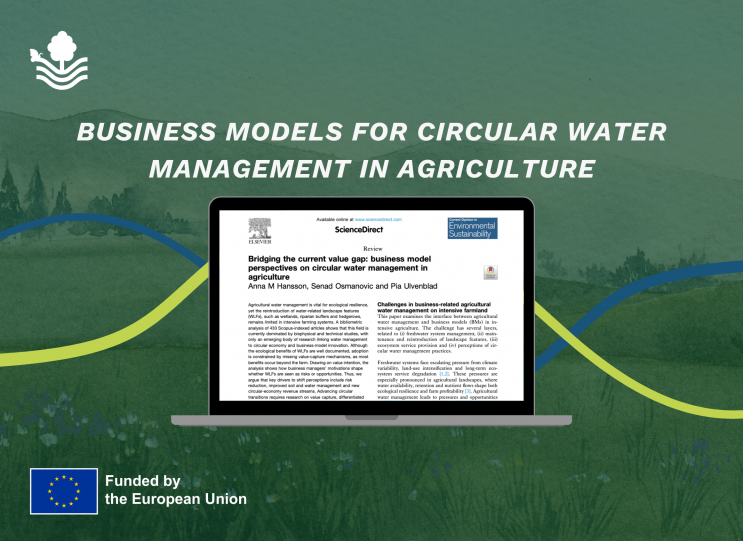
A new peer-reviewed article published by our partner Halmstad University offers valuable insights into circular water management in agriculture, addressing a key challenge in the restoration of landscape features (LF).
The article, titled Bridging the current value gap: business model perspectives on circular water management in agriculture, was written by Anna Hansson, Senad Osmanovic, and Pia Ulvenblad (Halmstad University). It explores how innovative business models can help farmers adopt water-related LF, such as wetlands, riparian buffers, and hedgerows.
While the ecological benefits of these LF are well-known, their actual adoption on farms remains limited. The authors explain that this gap exists because many of the benefits occur beyond the individual farm, making it difficult for land managers to see direct financial returns.
By analysing existing research, the article demonstrates how the pеrceptions of business managers influence whether LFs are seen as financial risks or opportunities. The study identifies key drivers that can shift these perceptions, including risk reduction, improved soil and water management, and new revenue streams linked to the circular economy.
The findings highlight the need for further research on creating flexible business models, monetising environmental resilience, and removing practical barriers for farmers. These insights support the ongoing efforts within the LAFERIA project to develop viable economic models and encourage the widespread restoration of LF across Europe.
The full article can be found here.