LAFERIA's annual Consortium meeting in 2026
The LAFERIA Consortium had its first annual meeting after the kick-off of the project in January 2025. The meeting was held online and focused on reviewing the work and results so far, as well as on aligning the future goals for restoring landscape features (LF) across Europe.
The Lead Project Coordinator, Francisco Moreira (BIOPOLIS), started the meeting by welcoming all new Consortium members and going over the objectives for the day.
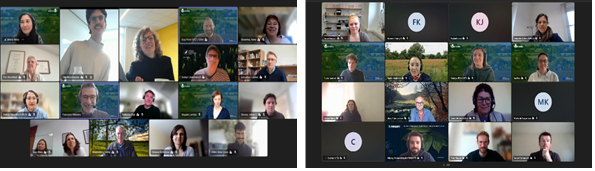
The discussion was then joined by the rest of the Coordination and Project Management Work Package Leads, namely Ângela Lomba (BIOPOLIS), Marta Neto (BIOPOLIS), and Guy Pe’er, (UFZ/iDIV), and continued with a brief overview of some practical project matters regarding deliverables and milestones.
The meeting continued with Yanka Kazakova (STEP) and Théo Paquet (EEB) taking the floor and focusing on a few main points: the Inception Workshops, aimed at the official start of on-the-ground stakeholder engagement, the coordination between the 7 case studies, some current challenges, and the proposed actions to be taken to overcome them.
The Consortium then eased into presentations on the case studies, each of them highlighting objectives, main activities so far, and current challenges.
Case Studies
Portugal (led by EDIA) - its inception workshop is scheduled for mid-April and is designed to identify drivers and barriers for reintroducing LF in intensive olive groves.
Finland (led by SYKE) - By partnering with local municipalities, this study uses practical demonstrations to show farmers how to maintain "wet and woody" features. The goal is to make the utilisation of these LF a standard practice nationwide.
Germany (led by UFZ/iDIV) - Researchers are using high-resolution GIS mapping to explore how large landowners can influence restoration. The project is developing new strategies to steer LF restoration across the wider agricultural countryside.
Bulgaria (led by STEP) - This study analyses land ownership along roads and irrigation channels to create a localised LF restoration plan and to overcome stakeholder engagement challenges. The team is also producing and providing Bulgarian-language materials to help farmers better understand the impacts and benefits of LF restoration.
the Netherlands (led by WUR) - By leveraging a strong partnership with farmers’ collectives, the study is looking for alternative funding sources as well as building a long-term strategic vision for managing the regional LF through 2026.
Belgium (led by ILVO) - This study focuses on showing farmers that, when cared for properly, LF are an asset, and not a burden, as well as on land consolidation, so that LF are connected in bigger areas rather than scattered.
Sweden (led by Halmstadt University) - Experts are working to bridge the gap between research and the farming community on the East Coast. They are exploring different farmer motivations to create inclusive business models that support LF restoration.
The meeting continued with Nikolay Mehandzhiyski (Pensoft Publishers), who talked about the results so far, highlighting the success of the project’s website and social media channels.
The status of LF in Europe’s agricultural systems and the benefits and costs for biodiversity, ecosystem services, climate change adaptation, and society at large were discussed by Irene Bouwma (WUR) and Irina Herzon (UH), respectively.
Marlinde Koopmans and Floris Huyghe (EV - ILVO) shared their progress on developing an inventory of instruments and mechanisms that could support farmers’ adoption and management of LF, as well as on mapping and reviewing LF reintroduction initiatives across Europe. Said initiatives will soon have a dedicated page on the project’s website, where it will be possible for anyone involved to also add new ones themselves.
Sebastian Lakner (UROS) talked about the drivers and challengers of LF reintroductions, mentioning as such the political and economic context of each case-study region, and the different views/perceptions of land managers and landowners on benefits and costs.
The presentations were closed by Guy Pe’er (UFZ/iDIV), who stressed the importance of networking and cooperation as the main long-term strategies for reintroducing LF.
The Consortium meeting ended after a brief discussion and feedback session.
Stay tuned for all things LAFERIA on our website as well as on our social media channels - LinkedIn and BlueSky.